


Am I a Good Candidate for a Hair Transplant? 7 Factors That Decide
Quick Answer You are likely a good hair transplant candidate if your hair loss has settled into a clear pattern, the back and sides of your scalp hold enough healthy…
 November 20, 2026
11 min read
Quick Answer
You are likely a good hair transplant candidate if your hair loss has settled into a clear pattern, the back and sides of your scalp hold enough healthy donor hair, and your general health allows a procedure under local anaesthesia. Seven factors decide it, and the doctor confirms them from your photos before you travel.
Technique, timing and recovery all come second to one question: will your hair respond well to a transplant? Whether you are a suitable hair transplant candidate depends on seven factors, starting with your donor area and ending with the texture of your hair. This guide explains who is a good candidate for a hair transplant, factor by factor, so you know where you stand before you send your photos.
Estecapelli is a medical aesthetics clinic with its own facility in Şişli, Istanbul. Every hair transplant plan at Estecapelli begins the same way: the doctor reviews the patient’s photos and personally plans the procedure, deciding the technique and graft count.
The 7 Factors at a Glance
| Factor | What the doctor checks | What works in your favour |
|---|---|---|
| 1. Donor area | Density and quality of hair at the back and sides | Dense, healthy hair across the safe donor zone |
| 2. Stability | How quickly the hair loss is progressing | A pattern that has slowed and become predictable |
| 3. Extent of thinning | How much the target area has thinned | Clearly thinned or bald zones with room for grafts |
| 4. Cause | The type of hair loss | Pattern hair loss (androgenetic alopecia) |
| 5. Age | Age together with the speed of progression | An adult whose pattern is easy to read |
| 6. General health | Conditions, medications, smoking, blood tests | Stable, well-managed health |
| 7. Hair characteristics | Thickness, curl and colour contrast with the skin | Thick, wavy or curly hair and low contrast |
Not sure how you score on some of these factors? Send a few photos of your scalp and the doctor will assess all seven for you.
How Does a Doctor Decide if You Are a Hair Transplant Candidate?
A doctor decides by weighing two things together: whether your donor area can supply enough healthy grafts, and whether the thinning area can receive and grow them. The American Academy of Dermatology describes exactly these two conditions as the basis for being considered for surgery. A review in the Indian Journal of Plastic Surgery adds a healthy scalp and good general health to the list.
At Estecapelli, the assessment of hair transplant eligibility starts with photos of your scalp. The doctor studies the donor zone, the thinning areas and your hair type, then recommends a technique and an estimated graft count in a written plan. A consultant who speaks your language handles your questions along the way.
The plan is then refined at the clinic. Blood tests check for infection risk, anaemia, blood sugar and clotting, and a TrichoLab scalp analysis measures follicle density, hair shaft thickness, donor capacity and the rate of miniaturisation. These measurements support the doctor’s clinical judgement rather than replace it.
Factor 1: Is Your Donor Area Strong Enough?
The donor area is the strongest predictor of whether you are a good hair transplant candidate. Hair at the back and sides of the scalp is genetically resistant to the hormone-driven thinning behind pattern baldness, so follicles moved from there keep growing in their new position.
Density matters most. According to StatPearls (NCBI Bookshelf), the safe donor zone typically holds 65 to 85 follicular units per square centimetre. The doctor measures your own donor density, how wide the donor zone is and how many hairs each follicular unit carries, then plans how many grafts can be moved.
Grafts are extracted in a planned, evenly spread pattern so the back of the head still looks full afterwards. If donor hair is limited or fine, the doctor may add the VITA protocol, which supports the scalp and grafts during the procedure. The back and sides of the scalp are the standard donor source. Beard hair is considered only as a last resort, after individual evaluation by the doctor. For more on how grafts are planned, see how hair transplant grafts are counted.
Factor 2: Has Your Hair Loss Pattern Settled?
A recognisable hair loss pattern helps the doctor plan with confidence. When the pattern is clear, the hairline and graft distribution can be designed so the result stays natural as the years pass.
Transplanted follicles are permanent. The doctor also maps the surrounding native hair, including any miniaturised (weakening) hairs, so the new hairline blends with it over time. For any hair transplant candidate, a stable pattern gives the hairline a longer-lasting, balanced look.
Factor 3: Is There Enough Thinning to Transplant Into?
A good candidate for a hair transplant usually has visible thinning in at least one area: a receding hairline, thinning temples, a sparse top or the crown. These are exactly the zones where transplanted grafts make the clearest difference.
When thinning is still mild, the doctor looks at where grafts will have the most visible effect and plans the density accordingly, placing them between existing hairs without disturbing them.
Factor 4: What Is Causing Your Hair Loss?
The cause of your hair loss often decides whether a transplant can give a lasting result. Pattern hair loss, known medically as androgenetic alopecia, is the classic indication: it follows a predictable map and leaves the donor area intact.
Other types of hair loss are planned around their timing. Sudden shedding after illness, stress or childbirth (telogen effluvium) is usually temporary, so the procedure is scheduled once the shedding has settled. For alopecia areata and scarring alopecias, the doctor looks for a long inactive period first; StatPearls refers to at least two years.
Factor 5: Does Your Age Matter?
Age matters less than most people think; on Estecapelli’s hair transplant page, good general health is described as more important than age. Many people in their thirties, forties, fifties and beyond make a good hair transplant candidate when the donor area is healthy.
For younger patients, age shapes the plan rather than the answer. In the early twenties, the doctor designs the hairline with future years in mind, uses donor hair wisely and advises on the best timing, so the result keeps looking natural as you get older.
Factor 6: Is Your General Health Ready for Surgery?
A hair transplant is a minor surgical procedure, so stable general health is part of being a hair transplant candidate. People with conditions such as high blood pressure, diabetes, heart disease or hormonal disorders can often have a hair transplant when the condition is well controlled and shared with the doctor in advance.
Medications deserve the same openness. Blood thinners such as aspirin are only paused under medical supervision, and no medication should be stopped without your doctor’s approval. Smoking reduces blood flow to the scalp, so patients are asked to stop at least one day before the procedure and for a week afterwards. Specific situations are covered in our articles on hair transplants for diabetic patients and hair transplants for HIV-positive patients.
Factor 7: Do Your Hair Characteristics Help Coverage?
Almost every hair type can be transplanted; hair characteristics shape how full the result looks with a given number of grafts. Three traits make the biggest difference: thickness, curl and colour contrast.
- Thickness: thicker hair shafts cover more scalp per graft, which helps create a denser appearance.
- Curl and wave: wavy or curly hair lifts away from the scalp and hides it more effectively than straight hair.
- Colour contrast: when hair and skin tones are close, such as grey or fair hair on light skin, density looks fuller. With dark hair on light skin, the doctor places grafts along the hairline with extra precision for a soft, natural transition.
Afro-textured hair grows from curved follicles, and extraction is planned around that natural curve. The American Society of Plastic Surgeons also lists colour, texture and curl among the factors that influence the cosmetic result.
Can Women Be Hair Transplant Candidates?
Yes. A woman with stable hair loss and a healthy donor area at the back of the scalp is often a good candidate for a hair transplant. A female hair transplant works best for thinning along the part line, a widening hairline or sparse temples.
Because hair loss in women more often has a hormonal or medical cause, the doctor first identifies that cause so the plan fits it. For women, the doctor usually recommends DHI, as it allows implantation without shaving existing hair. The procedure is planned after pregnancy and breastfeeding, once hormones and hair have settled.
When Is the Right Time for Your Hair Transplant?
For most people who wonder whether they are a hair transplant candidate, the real question is timing. The table below shows who is a good candidate for a hair transplant today and when others can plan theirs; your own timeline comes from the doctor’s evaluation.
| Your situation | Typical timing |
|---|---|
| Stable pattern hair loss with a strong donor area | Ready to plan now |
| Early twenties with hair loss still developing | Planned with the future hairline in mind; timing advised by the doctor |
| Sudden shedding after illness, stress or childbirth | Planned once the shedding has settled |
| Active alopecia areata or scarring alopecia | Planned after a long inactive period |
| Pregnancy or breastfeeding | Planned after this period |
A later date does not change your hair transplant eligibility; it simply means the doctor schedules the procedure for the moment it will give the best result.
Non-surgical care while you wait
For early to moderate thinning or temporary shedding, Estecapelli also offers hair mesotherapy: micro-injections of a customised vitamin, mineral and amino acid mixture into the scalp, with no downtime. It strengthens existing follicles in the meantime and can later support the results of a transplant. The doctor recommends it when it suits the cause of your hair loss.
Does Being a Good Candidate Change the Technique or the Price?
Your profile as a hair transplant candidate shapes the technique, but not the price model. The doctor decides between Sapphire FUE and DHI based on your donor area, the zones to be treated and your hair type; you can read how the two compare in our guide to FUE vs DHI.
Estecapelli works with a fixed, all-inclusive price between $1,700 and $4,500, whatever the graft count. Within that range, the technique sets the price. Extensive hair loss that needs more grafts therefore does not raise the cost of your procedure.
Curious which technique would suit your hair? Ask for a personal evaluation and receive the doctor’s recommendation in writing.
How Can You Find Out if You Are a Hair Transplant Candidate?
The quickest way is a photo-based evaluation by the doctor. Clear photos let the doctor judge your donor density, pattern and hair type before you plan any travel. Take them in natural daylight with dry hair and no styling products:
- Front view with your hairline visible
- Top of the head, looking down
- Crown, photographed from above and behind
- Back of the head (your donor area)
- Left and right sides, including the temples
Mention any health conditions and regular medications with your photos. A consultant in your language will guide you, and the doctor’s assessment comes back as a written plan with the recommended technique and graft estimate.
Find out if you are a good candidate
Send your photos to Estecapelli today and get the doctor’s personal assessment of your donor area, hair loss pattern and the best technique for you. Start your evaluation
Hair Transplant Candidate FAQs
Is there a hair transplant age limit?
There is no fixed upper hair transplant age limit. Older adults often make a strong hair transplant candidate, because their hair loss pattern is usually stable and easy to plan. What matters is a healthy donor area and general health that allows a procedure under local anaesthesia, which the doctor checks through your medical history and pre-operative blood tests.
Can I get a hair transplant in my early twenties?
Yes, many people have a hair transplant in their twenties. At this age, the doctor designs the hairline with future years in mind and checks how your hair loss is developing and how much donor hair you have, then advises on the best timing for your procedure.
Can I have a hair transplant if my hair is thin all over?
Yes, diffuse thinning can often be treated with a transplant when the back and sides of the scalp remain dense. The doctor first identifies the cause, because temporary shedding and pattern hair loss are planned differently, and then decides how to spread the grafts for an even, fuller look.
Does grey or white hair affect whether I am a candidate?
Grey or white hair does not prevent a hair transplant. When hair colour is close to skin tone, the contrast is low, which can make transplanted areas look fuller. The doctor still assesses donor density and hair thickness in the usual way.
Do I have to stop smoking to have a hair transplant?
Smokers can have a hair transplant. Because smoking reduces blood flow to the scalp, which grafts need while they settle, a short break is required. Patients are asked to stop smoking at least one day before the procedure and to avoid it for a week afterwards. Mention your smoking habits when you send your photos, so the doctor can take them into account.
Can I be a hair transplant candidate if I have diabetes?
Yes, many people with diabetes can have a hair transplant when their blood sugar is well controlled. Pre-operative blood tests include blood sugar levels, and the doctor reviews your medications in advance. Our article on diabetes and hair transplants covers this in more detail.
Sources
- StatPearls: Hair Transplantation (NCBI Bookshelf, National Library of Medicine)
- American Academy of Dermatology: Hair transplant
- American Society of Plastic Surgeons: Hair transplantation candidates
- True RH. Is Every Patient of Hair Loss a Candidate for Hair Transplant? Indian Journal of Plastic Surgery, 2021
This article is general information and does not replace a personal medical evaluation.
Last updated: November 2026. Reviewed by the Estecapelli medical team.
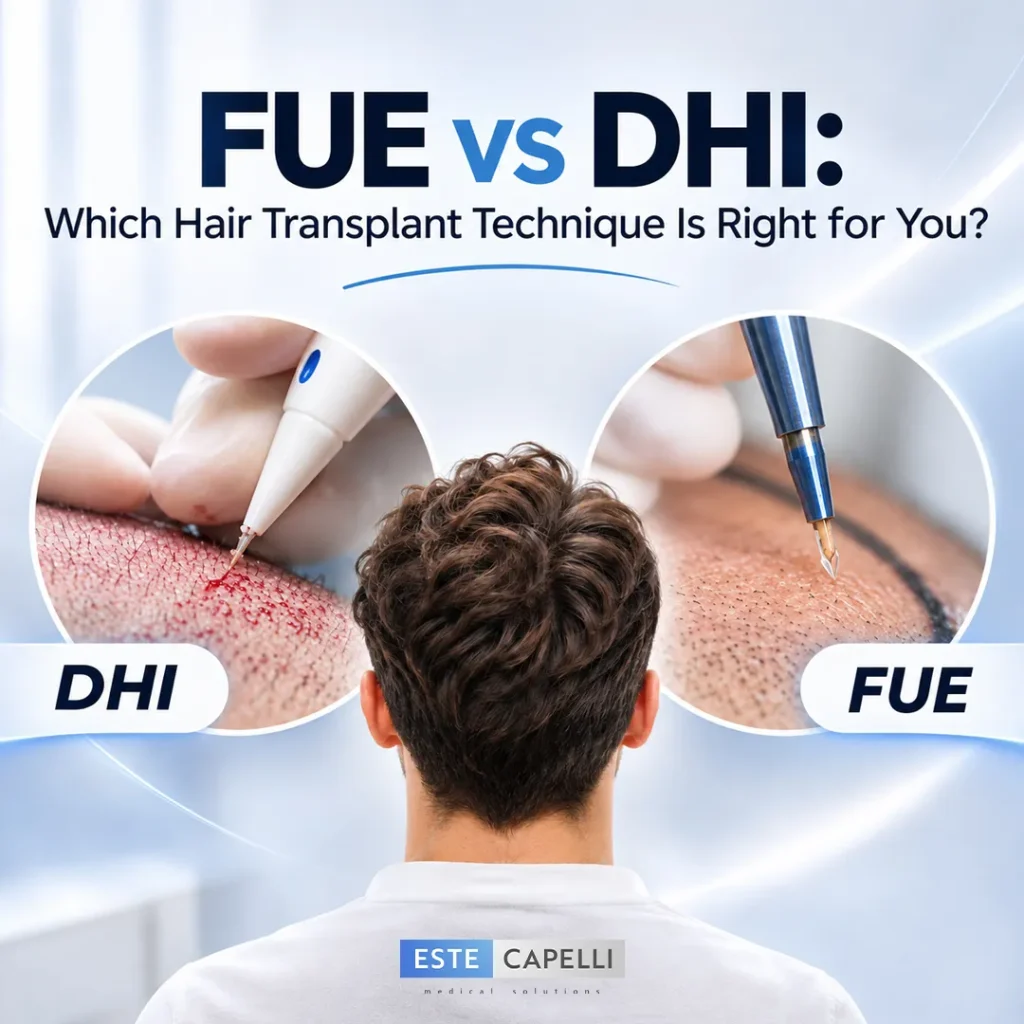
FUE vs DHI: Which Hair Transplant Technique Is Right for You?
Quick Answer FUE vs DHI comes down to how grafts are placed, not how they are taken. Both techniques harvest follicles one by one…
Read more
Eyebrow Transplant Cost in Turkey: Prices, Grafts and What’s Included
Quick Answer The eyebrow transplant cost at Estecapelli in Istanbul is a fixed, all-inclusive price between €2,000 and €2,500. Where your case sits in…
Read more
Shock Loss After a Hair Transplant: Why It Happens & How to Reduce It
Quick answer: Shock loss after a hair transplant is temporary shedding that usually starts 2 to 8 weeks after surgery. Transplanted hairs fall out…
Read more