


FUE vs DHI: Which Hair Transplant Technique Is Right for You?
Quick Answer FUE vs DHI comes down to how grafts are placed, not how they are taken. Both techniques harvest follicles one by one from the donor area. Sapphire FUE…
 November 5, 2026
11 min read
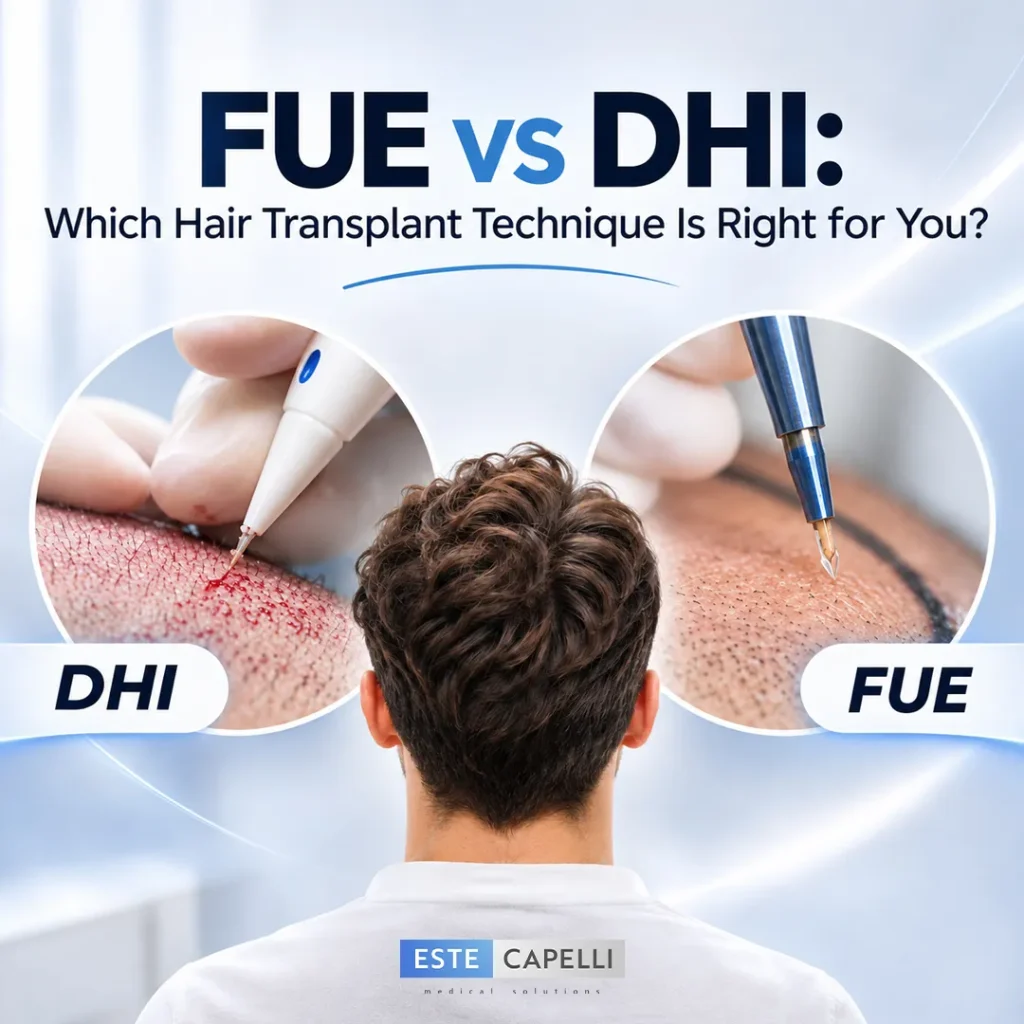
Quick Answer
FUE vs DHI comes down to how grafts are placed, not how they are taken. Both techniques harvest follicles one by one from the donor area. Sapphire FUE opens all recipient channels first and then places the grafts, while DHI implants each graft directly with a Choi pen. DHI suits targeted, often unshaven work; Sapphire FUE suits larger, shaved sessions.
Read enough clinic pages and the FUE vs DHI question starts to sound like a choice between an old operation and a new one. It is not. DHI is a variation of FUE, and the two share exactly the same donor work. This guide explains the real difference between FUE and DHI, which situations tend to favour each method, and how the medical team decides which one fits your scalp.
| Sapphire FUE | DHI | |
|---|---|---|
| Graft harvesting | One by one with ultra-fine micromotors | Identical to FUE |
| Recipient channels | Opened first with sapphire-tipped blades | Created by the pen at the moment of implantation |
| How grafts go in | Placed into the pre-opened channels | Loaded into a Choi implanter pen and placed in one motion |
| Shaving | Donor and recipient areas usually shaved; partial-shave options can be discussed | Often possible without shaving for smaller areas; larger sessions may need a partial or hidden trim |
| Often considered for | Wider areas where a full shave is acceptable | Hairline refinement, diffuse thinning, density between existing hairs |
| Result timeline | New growth from month 3 to 4, final result at about 12 months | Same timeline |
| VITA protocol | Can be combined | Can be combined |
What Is the Real Difference Between FUE and DHI?
The real difference in FUE vs DHI is the implantation step. In both techniques the medical team extracts follicular units one at a time from the back and sides of the scalp, where hair is genetically resistant to thinning. The donor side of the procedure is therefore the same; only the way the grafts enter the recipient area changes.
FUE extraction uses very small punches, typically between 0.8 and 1.15 mm wide. A review in Actas Dermo-Sifiliográficas lists less discomfort in the donor zone and barely visible punch scars among the main advantages of the method. Because DHI uses the same extraction, it shares these benefits.
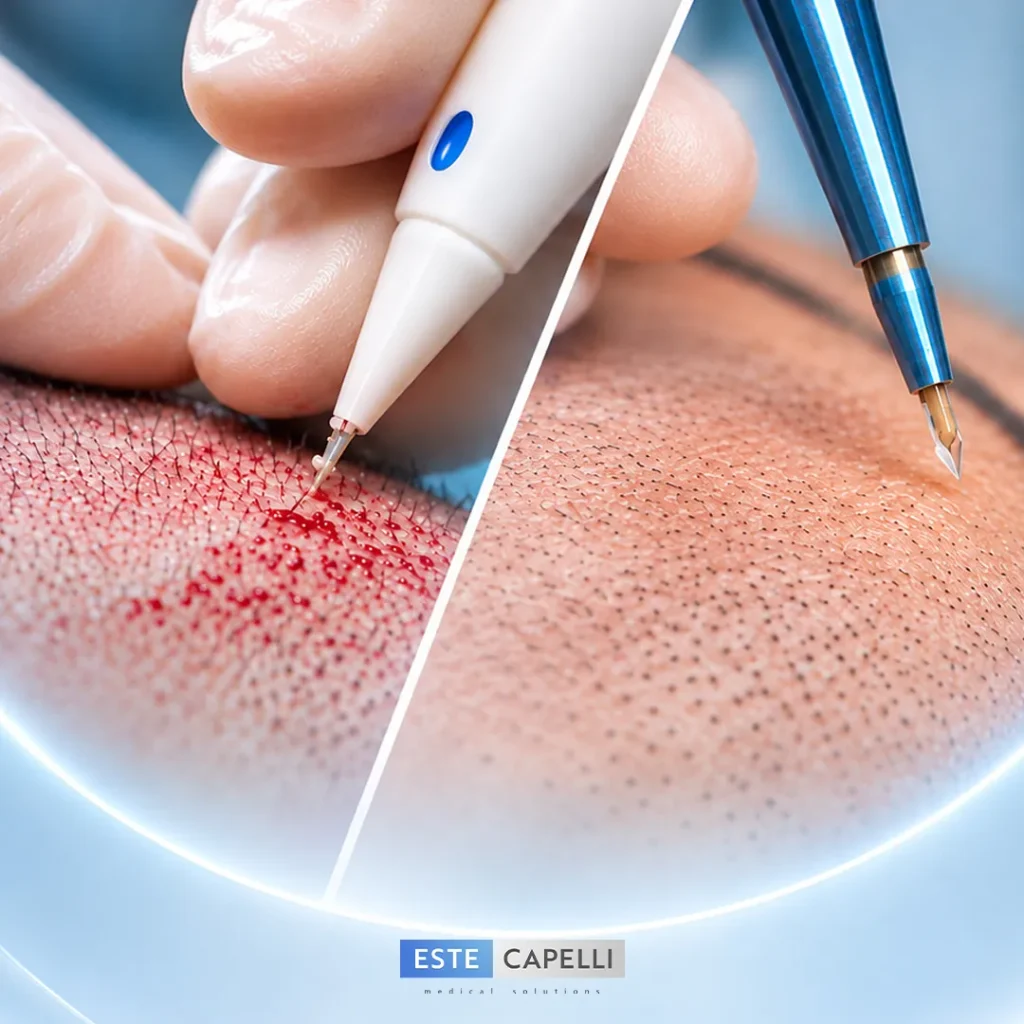
The split comes afterwards. With Sapphire FUE, the team first opens the recipient channels with sapphire-tipped blades and then places each graft into them. With DHI, each graft is loaded into a Choi implanter pen, and the pen creates the channel and leaves the graft in place in a single movement. A 2023 paper in Clinical, Cosmetic and Investigational Dermatology calls these the two-step pre-made site method and the one-step stick-and-place method.
Is DHI Better Than FUE, or Just Different?
In the DHI vs FUE debate, neither method wins across the board; each placement method has strengths that matter in particular cases. The implanter gives very fine control over the angle of every hair, while pre-opened channels give the team a prepared, even field to work in across a wide area.
The same 2023 paper explains that, because incision and insertion happen together, the implanter angle can be adjusted to each hair’s curl and thickness. The authors also note less risk of crushing the follicle than when grafts are gripped with forceps. On the other side, they describe the implanter method as labour intensive, dependent on a well-coordinated team of loaders and assistants, and more demanding in patients who bleed easily. They add that the pre-made slit approach is useful in firm skin, including scar tissue, and that one patient may receive more than one placement method in different scalp regions.
Sapphire FUE has its own precision advantage. The sapphire edge stays sharp and makes fine, smooth incisions, so grafts can sit close together at the right angle and direction. In practice, the Sapphire FUE vs DHI decision is less about which tool is superior and more about which one suits your scalp, your hair and the area to be covered.
FUE vs DHI: Which Technique Fits Your Situation?
The right technique depends on where you are losing hair, how much area needs coverage and whether you can shave. The table below shows how these factors usually point, based on Estecapelli’s treatment information and the literature above.
| Your situation | Technique often considered | Why |
|---|---|---|
| Receding hairline, you want to keep your current hair length | DHI | Grafts go in between existing hairs, often without shaving |
| Diffuse thinning where hair is still present | DHI | Dense, angle-controlled placement next to existing hair |
| Large bald area on top, a full shave is fine | Sapphire FUE | The whole recipient area is prepared with fine sapphire channels before placement |
| Firm scalp skin or scar tissue | Sapphire FUE | Pre-opened channels are described as useful in firmer skin |
| Sparse or patchy beard | Sapphire FUE or DHI | Chosen for the area and the look you want; see beard transplant |
| Thin or over-plucked eyebrows | Long FUE or DHI | Brow hairs need a very shallow, precise angle; see eyebrow transplant |
These are tendencies, not rules. Two people with the same hairline can receive different recommendations because their donor density, hair calibre or skin differ, which is why the technique is set after your photos are assessed.
Not sure where your case fits? Send a few photos of your hairline, crown and donor area and the medical team will tell you which technique they recommend and why.
Does DHI Grow More Hair Than FUE?
In the FUE vs DHI comparison, neither technique produces more growth on its own. Graft survival depends mainly on how grafts are treated between extraction and placement: how long they stay outside the body, whether they are kept moist and cool, and how gently they are handled. Those fundamentals apply to DHI and FUE equally.
A review in the Journal of Cutaneous and Aesthetic Surgery names hydration, temperature, time out of body and gentle handling as the basics surgeons should focus on first. It reports that grafts left in a dry environment can start dying within minutes, with published figures ranging from about 3 to more than 16 minutes. In other words, the care of the grafts matters more than the brand of the instrument.
This is where Estecapelli’s own protocols come in. The VITA protocol keeps harvested grafts in a vitamin-based serum under cold-air vapour and can be combined with both Sapphire FUE and DHI. Exosome FUE holds grafts in an exosome-rich solution while they are outside the body.
Do You Need to Shave for FUE or DHI?
Shaving is one of the most practical FUE vs DHI differences. Sapphire FUE usually involves shaving both the donor and recipient areas, which gives the team full visibility for opening and filling the channels. Partial-shave options can still be discussed during your consultation.
DHI is the technique best suited to unshaven and targeted procedures. For hairline work and density between existing hairs, your current hair can often be kept fully intact. For larger procedures, a partial or hidden trim may be needed, and the team confirms what is possible from your photos. Keeping your hair unshaven is an advantage of DHI, not a reason on its own to choose it: if the area is large or your donor area calls for it, the medical team may recommend Sapphire FUE or a partial trim because that suits your case better. If keeping your length matters for work or personal reasons, our guide to the unshaven hair transplant covers how it works in more detail.
How Do FUE and DHI Compare for Recovery and Results?
Recovery is one area where the FUE vs DHI gap is small, and the growth timeline is identical. Each procedure is performed under local anaesthesia: you stay awake, feel no pain during the session and return to your hotel the same day. A session typically lasts six to eight hours, depending on the number of grafts.
- First days: mild redness and swelling are normal and settle quickly.
- Days 7 to 14: small scabs loosen and come off with gentle washing. Because DHI creates no separate channels, small scabs tend to settle within days.
- First two weeks: strenuous activity, direct sun and swimming are avoided.
- First weeks to month 3: transplanted hairs often shed. This shock shedding is expected and does not harm the follicles.
- Months 3 to 4: new growth begins.
- Months 6 to 9: density becomes noticeable.
- Around month 12: the final, mature result is visible.
Most patients plan for about three days in Istanbul, which covers the procedure, the first wash and a personal aftercare briefing. The day-by-day healing timeline walks through each stage.
Does the Technique Change the Price at Estecapelli?
Yes. At Estecapelli the technique is what places your quote within a fixed, all-inclusive range of $1,700 – $4,500. The number of grafts does not change the price, so the FUE vs DHI choice never becomes a graft-by-graft calculation. Cost only rises if you add a separate treatment to the same trip.
The package covers pre-operative blood tests, the procedure with the agreed technique under local anaesthesia, your stay at a partner hotel, VIP transfers between the airport, hotel and clinic, a personal translator, the first wash with an aftercare kit, and a dedicated follow-up team once you are home. Our guide to what a hair transplant package includes explains each item.
How Does the Medical Team Choose Between FUE and DHI for You?
The medical team settles the FUE vs DHI question from a photo analysis before you travel, so you know the method and your quote before you book. The steps are:
- Send your photos: front, top, crown and the back of your head, through the contact form or WhatsApp.
- Receive a recommendation: the team assesses your hair loss, donor area and goals, then recommends Sapphire FUE or DHI with a graft estimate. Your quote names the technique.
- Plan on the day: at the clinic, blood tests and an AI-supported TrichoLab analysis refine the hairline design and graft distribution. Your quote stays the same.
- Procedure and aftercare: the agreed technique is performed, followed by the first wash and your aftercare routine.
When you read your quote, look for the technique named clearly, a plain list of what the package covers and a description of how follow-up works after you fly home. If you have a preference, such as keeping your hair long for work, mention it at the start. The team can then tell you whether DHI suits your case or explain why Sapphire FUE would serve you better.
Estecapelli is a medical aesthetics provider with its own clinic in Şişli, Istanbul, offering hair transplant, plastic surgery and dental treatments. Both Sapphire FUE and DHI are performed there by its medical team, with each plan built around the patient’s scalp and donor area.
Ready to find out which technique suits you? Book a free consultation and receive a personalised recommendation with a no-obligation quote.
FUE vs DHI: Frequently Asked Questions
Is Sapphire FUE the same as FUE?
Sapphire FUE is a refinement of classic FUE. Grafts are harvested in exactly the same way, but the recipient channels are opened with sapphire-tipped blades instead of steel ones. The sapphire edge stays sharp and makes smaller, smoother incisions, which allows grafts to be placed close together with less tissue trauma. At Estecapelli, the practical comparison is therefore Sapphire FUE vs DHI.
Is DHI more painful than FUE?
No. Pain is not a deciding factor in DHI vs FUE, because both are performed under local anaesthesia, so you remain awake but feel no pain during the session. Most patients describe only mild discomfort when the anaesthetic is first applied. Afterwards, mild redness and tenderness settle within a few days with either technique.
Are the results of FUE and DHI permanent?
Yes. With both techniques the follicles come from the back and sides of the scalp, where hair is genetically resistant to loss, so the transplanted hair keeps growing for life. You can cut, wash and style it normally. Your existing, non-transplanted hair follows its own pattern and may still thin over time.
Which technique leaves less visible scarring?
In the donor area there is no difference, because DHI and FUE use the same extraction with tiny punches that heal as small, barely visible dots rather than a line. In the recipient area, Sapphire FUE uses very fine incisions and DHI creates no separate channels, so both heal discreetly.
Who is not a good candidate for either technique?
People with uncontrolled diabetes, severe heart or liver problems, active scalp infections or autoimmune disorders affecting hair growth may not be suitable for either technique. Candidates are generally over 25, when hair loss becomes more predictable, and types such as alopecia areata need a specialised evaluation first.
Can I choose DHI or FUE myself?
You can share a preference, and the team takes it seriously, especially when it is linked to shaving or how you wear your hair. The final recommendation comes from the analysis of your scalp and donor area, because the right placement method depends on your hair, not on the name of the technique.
Sources
- Park JH, Ho YH, Manonukul K. A Practical Guide to Hair Graft Placement Using the Sharp Implanter Method. Clinical, Cosmetic and Investigational Dermatology. 2023;16:1777-1785.
- Parsley WM, Perez-Meza D. Review of Factors Affecting the Growth and Survival of Follicular Grafts. Journal of Cutaneous and Aesthetic Surgery. 2010;3(2):69-75.
- Jiménez-Acosta F, Ponce-Rodríguez I. Follicular Unit Extraction for Hair Transplantation: An Update. Actas Dermo-Sifiliográficas. 2017;108(6):532-537.
This article is general information and does not replace a personal medical assessment.
Last updated: November 2026. Reviewed by the Estecapelli medical team.

Eyebrow Transplant Cost in Turkey: Prices, Grafts and What’s Included
Quick Answer The eyebrow transplant cost at Estecapelli in Istanbul is a fixed, all-inclusive price between €2,000 and €2,500. Where your case sits in…
Read more
Shock Loss After a Hair Transplant: Why It Happens & How to Reduce It
Quick answer: Shock loss after a hair transplant is temporary shedding that usually starts 2 to 8 weeks after surgery. Transplanted hairs fall out…
Read more
Hair Transplant Complications & Failure Rates: What’s Actually Normal
Quick answer: Serious hair transplant complications are uncommon. Large clinical series put the overall complication rate at about 1.2% to 4.7%, and most events…
Read more