


How Are Hair Transplant Grafts Counted? Grafts vs Density Explained
Quick answer: A hair transplant graft is one follicular unit, a natural cluster of 1 to 4 hairs, so the hair transplant graft count is always lower than the number…
 October 1, 2026
8 min read
October 1, 2026
8 min read
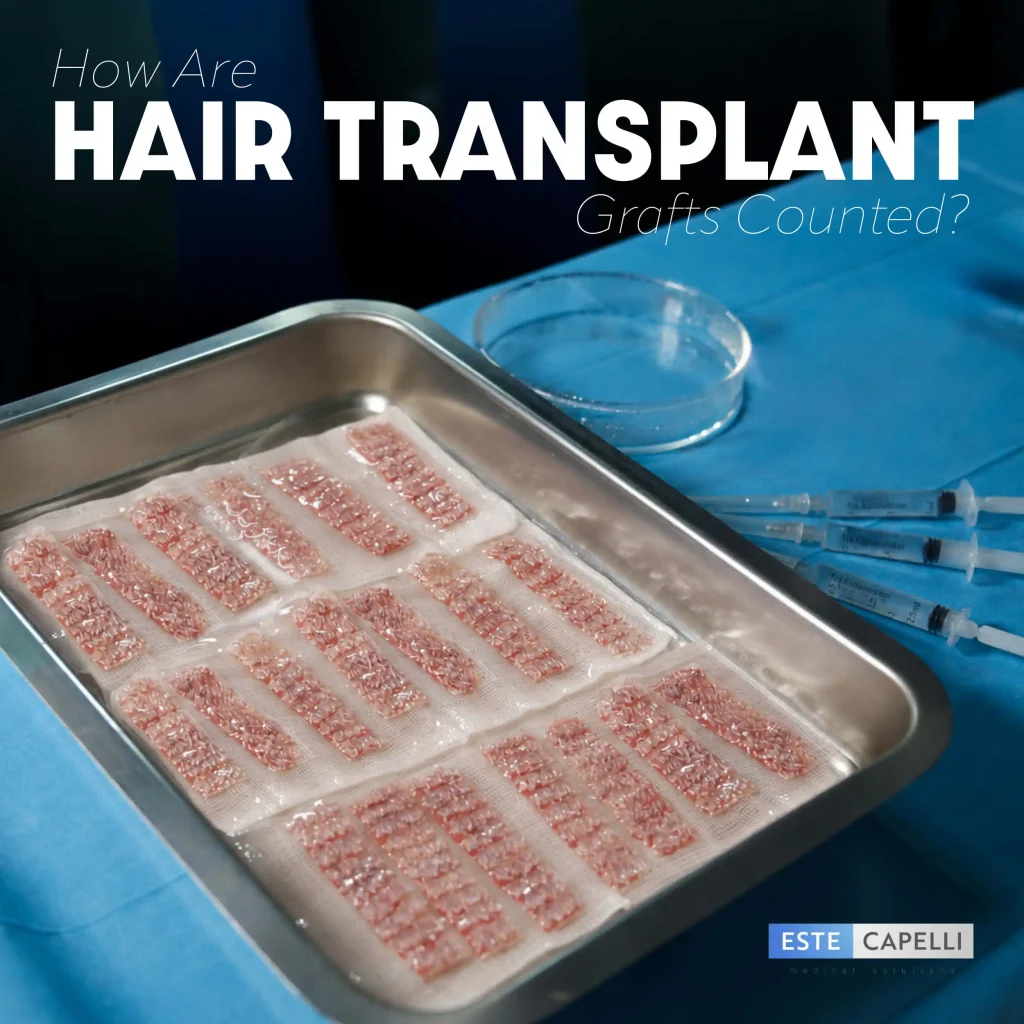
Quick answer: A hair transplant graft is one follicular unit, a natural cluster of 1 to 4 hairs, so the hair transplant graft count is always lower than the number of hairs moved. Grafts are counted by the surgical team under magnification as they are extracted, sorted by hair number and counted again before implantation. Density is a different measure: it is how many grafts are placed per square centimetre, usually 35 to 50 grafts/cm² in a transplanted zone, compared with 80 to 100 in a full natural scalp.
Most patients compare clinics by one number, but the hair transplant graft count only makes sense when you also know how many hairs each graft holds and how densely those grafts are placed. This guide explains how grafts are counted, why 3,000 grafts is not 3,000 hairs, how density turns into a graft number, and what to ask so the figure on your plan matches what you actually receive.
What is a hair transplant graft?
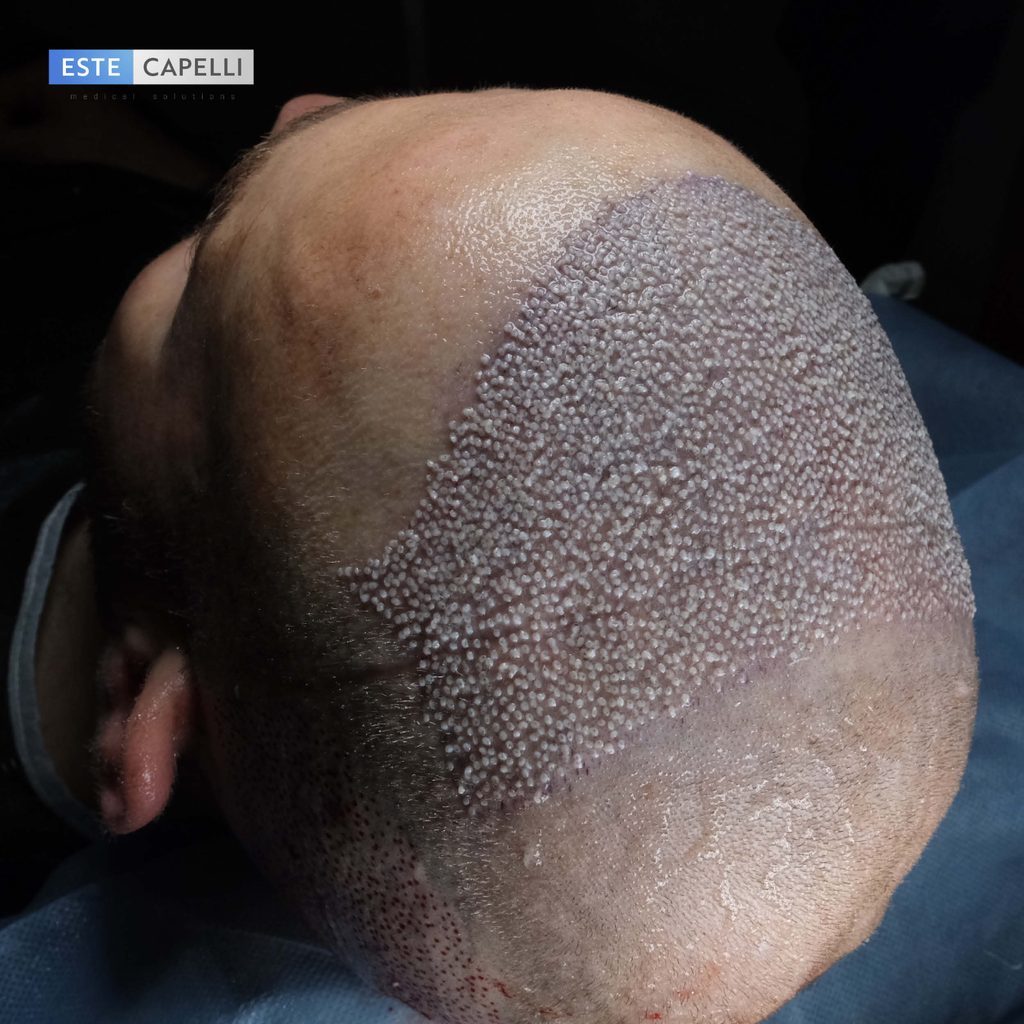
A hair transplant graft is a single follicular unit removed from the donor area with its surrounding tissue. Hair naturally grows in these small groups, and each unit contains 1, 2, 3 or occasionally 4 hairs that share one opening in the skin.
Surgeons use different graft types for different jobs, which is why the mix of grafts matters as much as the total:
| Graft type | Hairs per graft | Where it is usually placed |
|---|---|---|
| Single-hair graft | 1 | First rows of the hairline, temples, for a soft natural edge |
| Double-hair graft | 2 | Behind the hairline and the front third |
| Triple-hair graft | 3 | Mid-scalp, where volume matters most |
| Four-hair graft | 4 | Central areas and the crown, used sparingly |
In most patients, the average falls around 2 hairs per graft. A clinical study published on PubMed Central (NIH) measured an average of about 2.0 to 2.1 hairs per graft in FUE cases, and averages of 2.2 to 2.5 are common in patients with strong donor hair.
How are grafts counted during a hair transplant?
Grafts are counted by hand, under magnification, at two stages: when they are extracted and again before they are implanted. This double count is what makes the final hair transplant graft count on your report reliable.
- Extraction: each follicular unit is removed one at a time with a micro punch, as in Sapphire FUE.
- Sorting: the team checks every graft under a microscope or loupes, removes damaged ones and sorts the rest into 1, 2, 3 and 4 hair groups.
- Counting in batches: grafts are laid out in cooled storage solution in rows or trays of fixed size (for example rows of 10), so the total can be checked at a glance.
- Recount at implantation: grafts are counted again as they are placed, by forceps or with implanter pens in DHI hair transplant.
- Final record: the patient receives the total, ideally broken down by graft type.
Counting and sorting are normally done by trained technicians, while the surgeon plans the number and creates the recipient sites. If you want to know which steps should stay with the doctor, see our guide on who performs your hair transplant.
Grafts vs hairs: why the hair transplant graft count is not the hair count
The hair transplant graft count tells you how many units were moved, not how many hairs. Because the average graft holds about 2 hairs, the number of hairs is roughly double the number of grafts.
| Graft count | Approx. hairs at 2.0 per graft | Approx. hairs at 2.3 per graft |
|---|---|---|
| 1,500 grafts | 3,000 hairs | 3,450 hairs |
| 2,500 grafts | 5,000 hairs | 5,750 hairs |
| 3,000 grafts | 6,000 hairs | 6,900 hairs |
| 4,000 grafts | 8,000 hairs | 9,200 hairs |
This is also where marketing can mislead. An offer of “8,000 hairs” sounds larger than “4,000 grafts” but can be the same procedure. Always ask for the figure in grafts, and ask for the average hairs per graft so you can compare offers fairly.
What is hair density, and how is it different from hair transplant graft count?
Density is the number of follicular units in one square centimetre of scalp, written as grafts/cm² or FU/cm². The hair transplant graft count is the total for the whole procedure; density is how closely those grafts are packed in each zone.
- Natural scalp: about 80 to 100 follicular units per cm², or roughly 150 to 200+ hairs per cm².
- Transplanted zone: usually 35 to 50 grafts/cm², which looks full because hair loss only becomes visible after roughly half of the original density is gone.
- Donor area: the safe zone at the back and sides of the head, where only part of the follicles can be removed without visible thinning.
Two patients can both receive 3,000 grafts and get very different results if one has them spread over a large crown and the other concentrated on the hairline. That is why density by zone, not the total alone, predicts how the result will look.
How do surgeons turn density into a graft number?
The basic formula behind a hair transplant graft count is simple: recipient area in cm² multiplied by the target density gives the number. The skill lies in choosing the right density for each zone and checking that the donor area can supply it.
| Zone | Typical target density | Example area | Grafts needed |
|---|---|---|---|
| Hairline and front third | 40 to 50 grafts/cm² | 30 cm² | 1,200 to 1,500 |
| Mid-scalp | 30 to 40 grafts/cm² | 35 cm² | 1,050 to 1,400 |
| Crown | 25 to 35 grafts/cm² | 25 cm² | 625 to 875 |
In this example, the hair transplant graft count for full coverage would be about 2,900 to 3,800. If the donor area cannot safely provide that in one session, the surgeon prioritises the front, where density has the most visible impact, and plans the crown separately. Most surgeons take only around 25 to 30 percent of donor follicles per session to keep the back of the head looking natural.
Not sure what your own numbers look like? Send your photos on WhatsApp for a free graft estimate.
Why can the same hair transplant graft count look different on two patients?
The same hair transplant graft count can give different coverage because visible fullness depends on the hair itself, not only on the number of units. These are the factors that change the result:
- Hairs per graft: a donor averaging 2.5 hairs per graft gives about 25 percent more hair than one averaging 2.0, at the same graft count.
- Hair thickness: coarse hair covers far more scalp per strand than fine hair.
- Curl and wave: curly or wavy hair creates more visual volume.
- Colour contrast: low contrast between hair and skin, such as fair hair on fair skin, hides the scalp better.
- Graft survival: careful handling, short time outside the body and correct storage protect the grafts that were counted.
How can you check your hair transplant graft count?
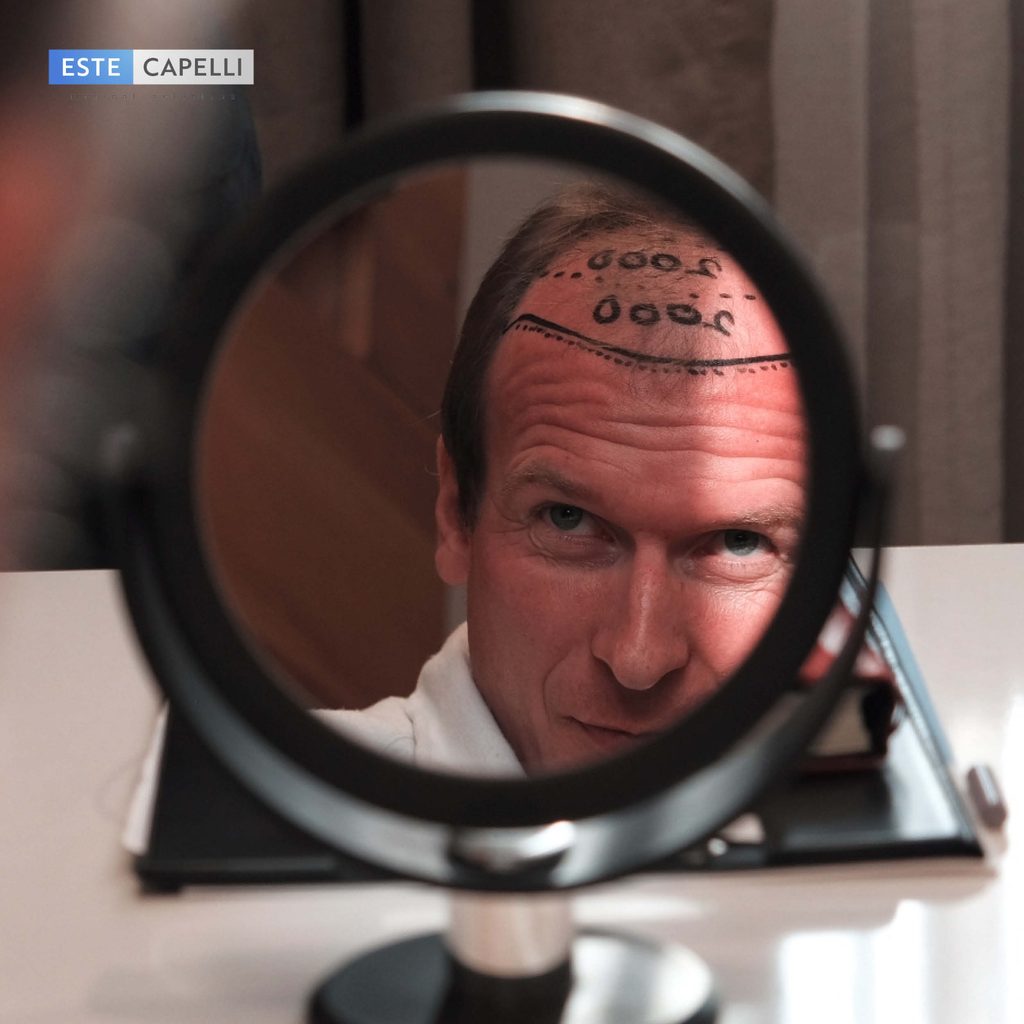
You can check your hair transplant graft count by asking for a written plan before surgery and a written breakdown after it. A transparent clinic will give you these without hesitation:
- The planned number of grafts, and the target density for each zone.
- The final count split by 1, 2, 3 and 4 hair grafts.
- The average hairs per graft for your donor area.
- Who counted and sorted the grafts, and how many were discarded.
- How the plan protects your donor area for possible future sessions.
The International Society of Hair Restoration Surgery (ISHRS) publishes patient guidance on planning and on choosing a qualified team, which is a useful reference for these questions. If you are considering a discreet approach, our guide on how many grafts a no shave transplant allows covers the session limits.
How does Estecapelli plan your hair transplant graft count?
At Estecapelli, your hair transplant graft count comes from a surgeon-led assessment of your donor area and the zones you want to restore, not from a sales target. The surgeon measures the area, sets a density for each zone and checks it against your donor capacity and likely future hair loss.
- You receive a written plan with the planned hair transplant graft count and the reasoning behind it.
- After surgery, you receive the final count broken down by graft type.
- Our fixed package model means a higher graft number does not change your price, so the count stays a medical decision.
- If one session cannot reach your goal safely, we explain a staged plan before you travel.
For patients who want extra support for healing, Exosome FUE can be added to the plan. Women with diffuse thinning follow a different density logic, covered on our female hair transplant page.
Frequently asked questions
Is one graft the same as one hair?
No. One graft is one follicular unit containing 1 to 4 hairs, with an average of about 2. A hair transplant graft count of 2,000 therefore usually means around 4,000 to 4,600 hairs.
How many hairs are in 3,000 grafts?
About 6,000 to 7,000 hairs, depending on how many hairs your donor grafts contain. Patients with many 3 and 4 hair units in the donor area get more hairs from the same hair transplant graft count.
What density looks natural after a hair transplant?
Around 35 to 50 grafts per cm² looks full to the eye in most patients, with the higher end used at the hairline and front. Natural scalp density is higher, but visible thinning only starts after about half of it is lost.
Do all counted grafts survive?
Not every graft survives, but in experienced hands survival is commonly reported in the region of 85 to 95 percent. Gentle handling, cool storage and a short time outside the body are what protect the grafts that were counted.
Can a clinic inflate the hair transplant graft count?
It is possible, for example by quoting hairs instead of grafts or by splitting natural units into smaller pieces. Asking for a written count split by 1, 2, 3 and 4 hair grafts, plus the average hairs per graft, is the simplest way to protect yourself.
Want to know your real graft count? Send us photos of your front, top, crown and donor area, and our team will reply with a graft estimate and target density for each zone. Get your free graft estimate on WhatsApp.

Eyebrow Transplant Cost in Turkey: Prices, Grafts and What’s Included
Quick Answer The eyebrow transplant cost at Estecapelli in Istanbul is a fixed, all-inclusive price between €2,000 and €2,500. Where your case sits in…
Read more
Shock Loss After a Hair Transplant: Why It Happens & How to Reduce It
Quick answer: Shock loss after a hair transplant is temporary shedding that usually starts 2 to 8 weeks after surgery. Transplanted hairs fall out…
Read more
Hair Transplant Complications & Failure Rates: What’s Actually Normal
Quick answer: Serious hair transplant complications are uncommon. Large clinical series put the overall complication rate at about 1.2% to 4.7%, and most events…
Read more