


Shock Loss After a Hair Transplant: Why It Happens & How to Reduce It
Quick answer: Shock loss after a hair transplant is temporary shedding that usually starts 2 to 8 weeks after surgery. Transplanted hairs fall out while their follicles stay alive under…
 October 12, 2026
13 min read
October 12, 2026
13 min read
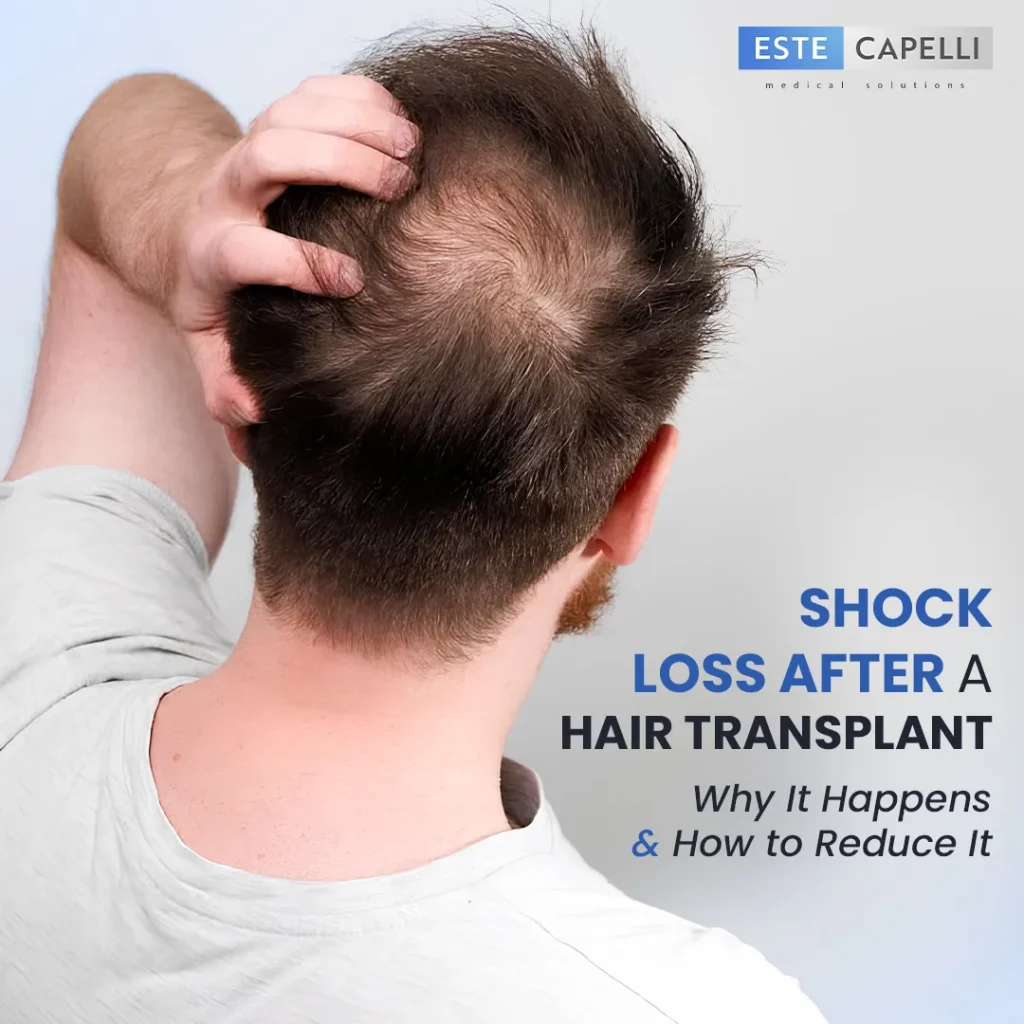
Quick answer: Shock loss after a hair transplant is temporary shedding that usually starts 2 to 8 weeks after surgery. Transplanted hairs fall out while their follicles stay alive under the skin, and nearby native hair can thin too. Regrowth typically begins around months 3 to 4. Gentle surgical technique, sensible graft density and treating existing hair loss early can reduce it.
If you are three weeks out and your new hairline seems to be disappearing, this guide explains what is happening and which shedding after hair transplant is normal. It covers why shock loss after hair transplant surgery occurs, how long it lasts, who is most at risk, what the evidence says about minoxidil and PRP, and the signs that point to something other than shock loss.
| Question | Typical answer |
|---|---|
| What sheds? | Transplanted hair shafts, and sometimes existing (native) hair in the recipient or donor area |
| When does it start? | Usually between weeks 2 and 8 after surgery |
| How common is it? | Shedding of transplanted hair is expected in most patients. Native hair shock loss affected 45.1% of 195 women in one multicenter study |
| When does regrowth start? | Around months 3 to 4 |
| When is the final result visible? | About 12 to 18 months, with the crown usually slowest |
| Is it permanent? | Usually not. Already weak, miniaturized native hairs may not all return |
| Can it be prevented? | Not completely, but its size can be reduced |
What Is Shock Loss After a Hair Transplant?
Shock loss after hair transplant is a temporary, stress triggered shedding of hair in the weeks after surgery. Doctors also call it postoperative effluvium. It can affect three groups of hair: the transplanted hairs themselves, the existing native hairs around the grafts, and occasionally the hair around the donor area at the back of the head.
The term is used loosely, which causes a lot of confusion online. In surgical literature, shock loss usually means the loss of existing, non transplanted hair in the recipient area, as described in a review of hair transplant complications by Garg and Garg. Many patient guides also use the term for the expected shedding of the transplanted hairs. This article covers both, because patients notice them at the same time, but the outlook for each one is different.
- Transplanted hair shedding: the new grafts release their hair shafts while the follicles stay in place and later regrow.
- Native hair shock loss: existing hairs between or around the grafts shed because of the surgical stress nearby.
- Donor area shock loss: hairs around the extraction zone thin temporarily, which is less common.
Why Does Shock Loss Happen?
Shock loss after hair transplant happens because surgery is a sudden stress for hair follicles. Harvesting, the tiny recipient incisions and the swelling that follows push many follicles from the growth phase (anagen) into the resting phase (telogen) at the same time. Resting hairs are released a few weeks later, which is why the shedding arrives as a wave rather than a trickle.
Several specific mechanisms add to that general stress:
- Graft stress: a transplanted follicle spends time outside the body and then several days without a full blood supply. Most grafts respond by dropping the hair shaft and keeping the living follicle, which restarts a fresh growth cycle.
- Trauma to neighbouring hairs: recipient sites created between existing hairs can irritate or injure the follicles next to them.
- Swelling and blood flow: the Garg and Garg review links native hair effluvium to postoperative edema and minor vascular trauma during slit creation, and notes that the role of adrenaline in the anaesthetic solution is still unclear.
- Very dense packing: in a Spanish series, 28 of 274 transplant patients developed an unusual line shaped shedding within days of surgery, mostly after dense packing at the temples. The authors suggest local oxygen shortage around the grafts, and the loss fully reversed within 3 months.
- Donor area load: removing many grafts from one zone, or spreading a very large session over two days, puts more stress on the hair that stays behind.

When Does Shock Loss Start and How Long Does It Last?
Shock loss after hair transplant usually starts between weeks 2 and 8, is most visible for many patients around the end of the first month, and is largely over by week 8 to 10. New hair from the transplanted follicles typically appears from month 3 to 4. Native hairs that were shocked out usually return on a similar schedule, sometimes slightly earlier.
| Period after surgery | What you will usually see |
|---|---|
| Days 1 to 14 | Scabs form and clear. A few hairs may leave with the scabs, which is normal |
| Weeks 2 to 8 | Main shedding window for transplanted hairs and any native hair shock loss |
| Months 2 to 3 | Quiet phase. The area can look similar to before surgery, or even thinner |
| Months 3 to 4 | Fine new hairs start to appear, often unevenly |
| Months 6 to 9 | Visible density builds as more follicles enter the growth phase |
| Months 12 to 18 | Final thickness and texture, with the crown maturing last |
Shock loss is only one stage of recovery. For swelling, scabs, washing and return to work, see our day by day hair transplant recovery guide.
Transplanted Hair Shedding vs Native Hair Shock Loss: What Is the Difference?
Transplanted hair shedding is expected and almost always temporary, because the follicle survives and regrows. Native hair shock loss affects the hair you already had, does not happen to everyone, and is usually temporary, but hairs that were already weak may not return. Knowing which one you are seeing changes how worried you should be.
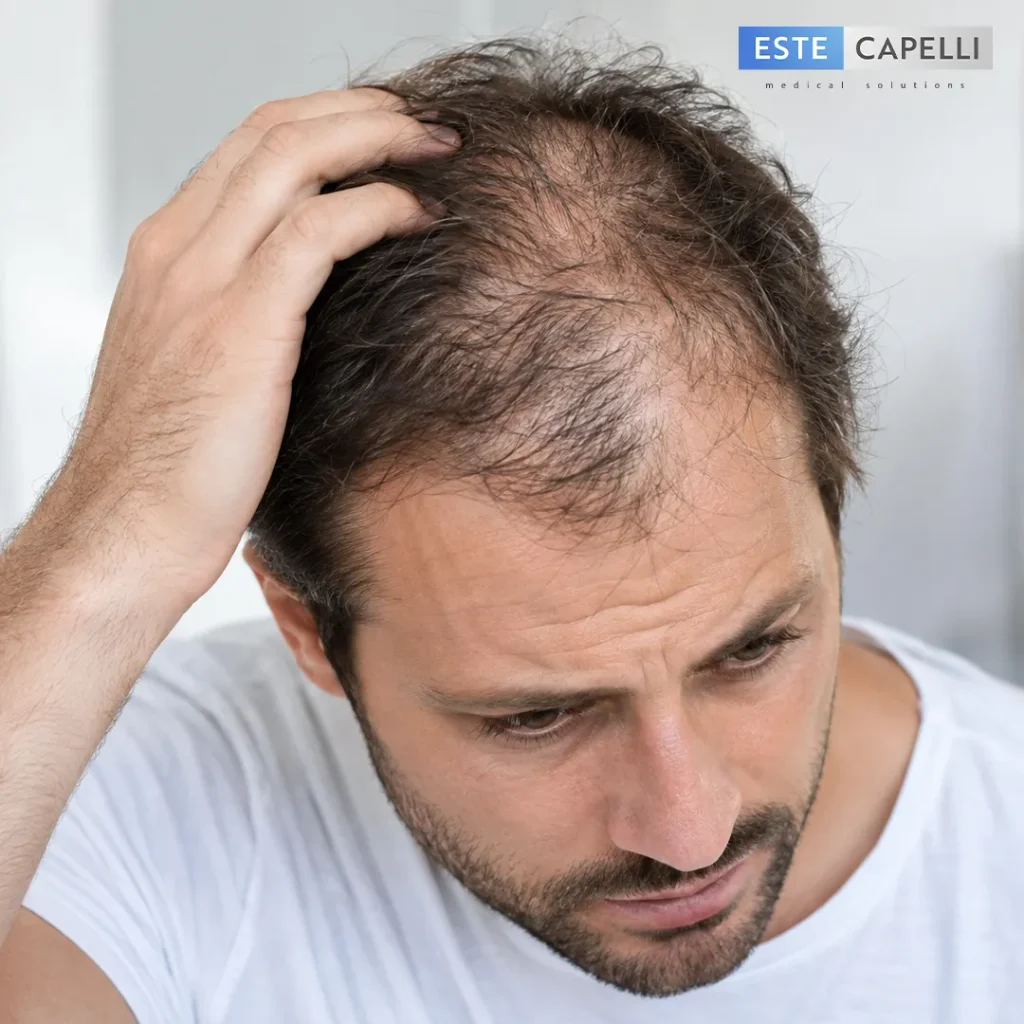
| Transplanted hair shedding | Native hair shock loss | Donor area shock loss | |
|---|---|---|---|
| What sheds | Hair shafts of the new grafts | Existing hair around the grafts | Hair around the extraction zone |
| How common | Expected in most patients | 45.1% of women in one study | 6.7% of women in the same study |
| Typical start | Weeks 2 to 6 | Weeks 2 to 8 | Weeks 2 to 8 |
| Grows back? | Yes, from months 3 to 4 | Usually; weak miniaturized hairs may not | Usually, within a few months |
| Main driver | Graft stress during transfer | Incision trauma, swelling, existing thinning | Extraction load in one area |
The incidence figures come from a 2024 Annals of Dermatology study of 195 women who had transplants for female pattern hair loss. Comparable large datasets for men are limited, so treat these numbers as a reference point rather than a universal rate.
Who Is More Likely to Get Shock Loss?
Shock loss after hair transplant is more likely when grafts are placed between existing hairs that are already thinning. The more native hair there is in the treated area, the more hair can shed temporarily, and the more the surgical plan matters. Patients who are completely bald in the recipient zone mainly experience transplanted hair shedding.
- Early or diffuse thinning with many miniaturized hairs in the area being treated
- Female pattern hair loss, where grafts are usually placed among existing hair
- Very dense packing, especially at the temples
- Large sessions or a high number of grafts taken from one donor zone
- Active, untreated androgenetic alopecia that was going to progress anyway
- Smoking and conditions that reduce scalp circulation, which can slow healing
How Can You Reduce Shock Loss After Hair Transplant?
You cannot fully prevent shock loss, but you can reduce how much hair sheds and support faster recovery. The biggest levers are the surgical plan and stabilizing native hair before surgery. Aftercare then protects what the surgery achieved.
- Stabilize native hair before surgery. If your existing hair is actively thinning, ask your doctor whether medical therapy makes sense first. Options differ between men and women, so this is a medical decision, not a shopping choice.
- Get a proper scalp analysis. Mapping how many hairs in the target zone are already miniaturized shows how much native hair is at risk. Estecapelli uses TrichoLab hair and scalp analysis for this step.
- Plan density realistically. Where a lot of native hair remains, a slightly lower density or a staged plan can cause less shock loss than packing grafts as tightly as possible.
- Choose a team that minimizes trauma. Small, correctly angled incisions, an even spread of extractions across the donor area and short out of body time for grafts all reduce stress on surrounding follicles.
- Follow your aftercare plan exactly. Wash as instructed, sleep with your head elevated in the first nights, do not scratch or pick scabs, and protect the scalp from direct sun.
- Avoid smoking and limit alcohol. Both reduce blood flow to the scalp. Estecapelli asks patients to avoid smoking for at least one week after the procedure.
- Ask about supportive treatments at the right time. Minoxidil, PRP or other treatments may help some patients, but your surgeon should decide whether and when to start them.
Planning a transplant while you still have hair around the target area? Our team can review your photos in a free consultation and explain how much native hair may be at risk and how the plan accounts for it.
Does Minoxidil or PRP Prevent Shock Loss?
Neither minoxidil nor PRP reliably prevents shock loss, but both have some evidence for reducing or shortening it. Most of that evidence comes from small or older studies, so they are best seen as useful options for selected patients, not guarantees. Always follow your surgeon’s timing, because some treatments are not suitable on a fresh wound.
| Option | What the evidence suggests | Limits |
|---|---|---|
| Topical minoxidil | An expert panel concluded it can speed regrowth in transplanted follicles and slow further loss of weak native hair | Based on clinical experience and small early studies; timing must be set by the surgeon |
| PRP (platelet rich plasma) | A randomized study of 40 FUE patients reported less early shedding and earlier regrowth with PRP | Small, single blind study; preparation methods vary between clinics |
| Finasteride (men) | Slows ongoing male pattern hair loss, which protects native hair long term | Little direct data on shock loss itself; not suitable for many women |
The minoxidil finding comes from an international panel of 11 hair loss experts published in Dermatologic Surgery. The PRP result comes from a prospective randomized study in 40 patients, where PRP was injected during FUE surgery. Neither study shows that shock loss can be switched off, and neither replaces a good surgical plan.
Is Shock Loss Permanent?
In most cases, shock loss after hair transplant is not permanent. Transplanted follicles come from the donor zone, which is genetically resistant to pattern hair loss, so they regrow after shedding. Healthy native hairs usually return within about 3 to 6 months. The main exception is native hair that was already miniaturized; some of those hairs may not come back.
Those weak hairs would often have been lost within a few years anyway, but losing them all at once can make the early months look worse than expected. This is why it is too early to judge density before month 6 to 9, and why the real result is assessed at 12 to 18 months. For why transplanted hair keeps growing long term, read will my hair fall out again after a hair transplant.
Shock Loss or Something Else? When to Contact Your Clinic
Even shedding in weeks 2 to 8 on a calm, healing scalp is typical shock loss. Patchy smooth bald spots, signs of infection, or no new growth by month 6 to 8 are not typical and should be checked. When in doubt, send clear photos to your clinic rather than waiting.
| What you notice | Likely meaning | What to do |
|---|---|---|
| Transplanted hairs falling out in weeks 2 to 8, scalp calm | Normal transplanted hair shedding | Continue aftercare and be patient |
| Native hair around the grafts thinning in the first 3 months | Usually native hair shock loss | Take monthly photos and share them at your check |
| Smooth, round, completely bald patches | Not typical of shock loss | Ask a doctor to rule out other scalp conditions |
| Pus, spreading redness, increasing pain or fever | Possible infection | Contact your clinic promptly |
| Little or no new growth by month 6 to 8 | Needs medical review | Book a follow up assessment |
| Donor thinning still clearly visible around month 9 | Possible over harvesting or another issue | Raise it with your surgeon |
For a wider view of what can go wrong and how often, see our article on hair transplant complications and failure rates.
How Estecapelli Plans for Shock Loss
Estecapelli is a medical aesthetics clinic in Şişli, Istanbul, Türkiye, that performs Sapphire FUE, DHI and Exosome FUE hair transplants alongside plastic surgery and dental treatments. For hair transplant patients, shock loss is discussed before surgery so it is expected, not feared.
Planning starts with a scalp analysis to see how much native hair sits in the target area. During surgery, the clinic’s VITA protocol keeps harvested grafts in a vitamin enriched serum with cold vapour and ends with one PRP session immediately after the procedure, with the aim of supporting graft survival and healing. No protocol removes shedding completely, and most patients still go through transplanted hair shedding.
After surgery, the first wash is done at the clinic on day 1 so patients learn the correct technique, and the patient care team reviews progress photos remotely. Supportive treatments such as PRP or mesotherapy may be recommended case by case. The full aftercare plan is on our post hair transplant period page.
Worried about shock loss before your procedure, or unsure whether what you see now is normal? Book a free consultation and send your photos to our medical team for a personal assessment.
Frequently Asked Questions About Hair Transplant Shock Loss
Does everyone get shock loss after hair transplant surgery?
Almost everyone sees some shedding of the transplanted hairs between weeks 2 and 8, because the grafts release their shafts before regrowing. Native hair shock loss is different and does not happen to everyone. In one study of 195 women, 45.1% had shock loss of existing hair in the recipient area. People with little native hair in the treated zone mainly notice graft shedding.
Can shock loss happen in the donor area?
Yes, but it is less common than recipient area shedding. In the same study of 195 women, 6.7% had donor area shock loss. It is more likely after very large sessions or when many grafts are taken from one zone. Donor shock loss usually recovers within a few months. Thinning that is still clearly visible around month 9 should be reviewed by your surgeon.
Does shock loss mean my hair transplant failed?
No. Shock loss is a normal response to surgery and says nothing about final graft survival. The follicles stay alive under the skin and usually start producing new hair around months 3 to 4. A hair transplant can only be judged fairly after 12 to 18 months. Little or no new growth by month 6 to 8 is the point at which a medical review makes sense.
Is shock loss worse with FUE or DHI?
There is no strong evidence that FUE or DHI as a technique decides how much shock loss you get. The factors that matter more are incision size and angle, how densely grafts are packed between existing hair, the size of the session and how carefully grafts are handled. Both Sapphire FUE and DHI can cause shedding, and both are usually followed by regrowth.
Should I wash my hair less during the shedding phase?
No. Washing does not cause hair transplant shock loss. Hairs that fall out in the shower were already in the resting phase and would have shed anyway. Skipping washes can let crusts and oil build up, which does not help healing. Keep following your clinic’s washing routine gently, and avoid rubbing, scratching or using harsh products on the treated area.
How do I know shock loss is ending?
The clearest signs are less hair in the shower and on your pillow, followed by short, fine new hairs from around months 3 to 4. Growth is often patchy at first. Taking a photo every month in the same light and from the same angles makes progress much easier to see than checking the mirror every day.
Sources
- Garg AK, Garg S. Complications of Hair Transplant Procedures: Causes and Management. Indian Journal of Plastic Surgery, 2021. PMC8719980
- Yun D, et al. Clinical Features of Patients Treated With Hair Transplants in Female Pattern Hair Loss. Annals of Dermatology, 2024. PMC11621641
- Mir-Bonafé JM, et al. Immediate Onset Linear Effluvium Associated With High Density Hair Transplantation: A Series of 28 Cases. Actas Dermo-Sifiliográficas, 2023. doi:10.1016/j.ad.2023.04.021
- Avram MR, et al. The potential role of minoxidil in the hair transplantation setting. Dermatologic Surgery, 2002. PubMed 12410672
- Garg S. Outcome of Intra-operative Injected Platelet-rich Plasma Therapy During Follicular Unit Extraction Hair Transplant: A Prospective Randomised Study in Forty Patients. Journal of Cutaneous and Aesthetic Surgery, 2016. PMC5064679
This article is general information, not personal medical advice. Speak to your surgeon before starting or stopping any treatment after a hair transplant.

Hair Transplant Complications & Failure Rates: What’s Actually Normal
Quick answer: Serious hair transplant complications are uncommon. Large clinical series put the overall complication rate at about 1.2% to 4.7%, and most events…
Read more
How Are Hair Transplant Grafts Counted? Grafts vs Density Explained
Quick answer: A hair transplant graft is one follicular unit, a natural cluster of 1 to 4 hairs, so the hair transplant graft count…
Read more
Who Performs Your Hair Transplant? Hair Transplant Surgeon vs Technician Roles Explained
Short answer: in a properly run clinic, the hair transplant surgeon is responsible for the medical decisions and the surgical steps: diagnosis, donor planning,…
Read more